On this page
Three key points
One gram is not the bomb’s mass; it is an energy-equivalent mass difference.
Hiroshima ≈0.7 g; Nagasaki ≈1 g, calculated from estimated explosive yields.
Archive footage, AI illustrations and recreated sound are distinguished.
What does one gram mean?
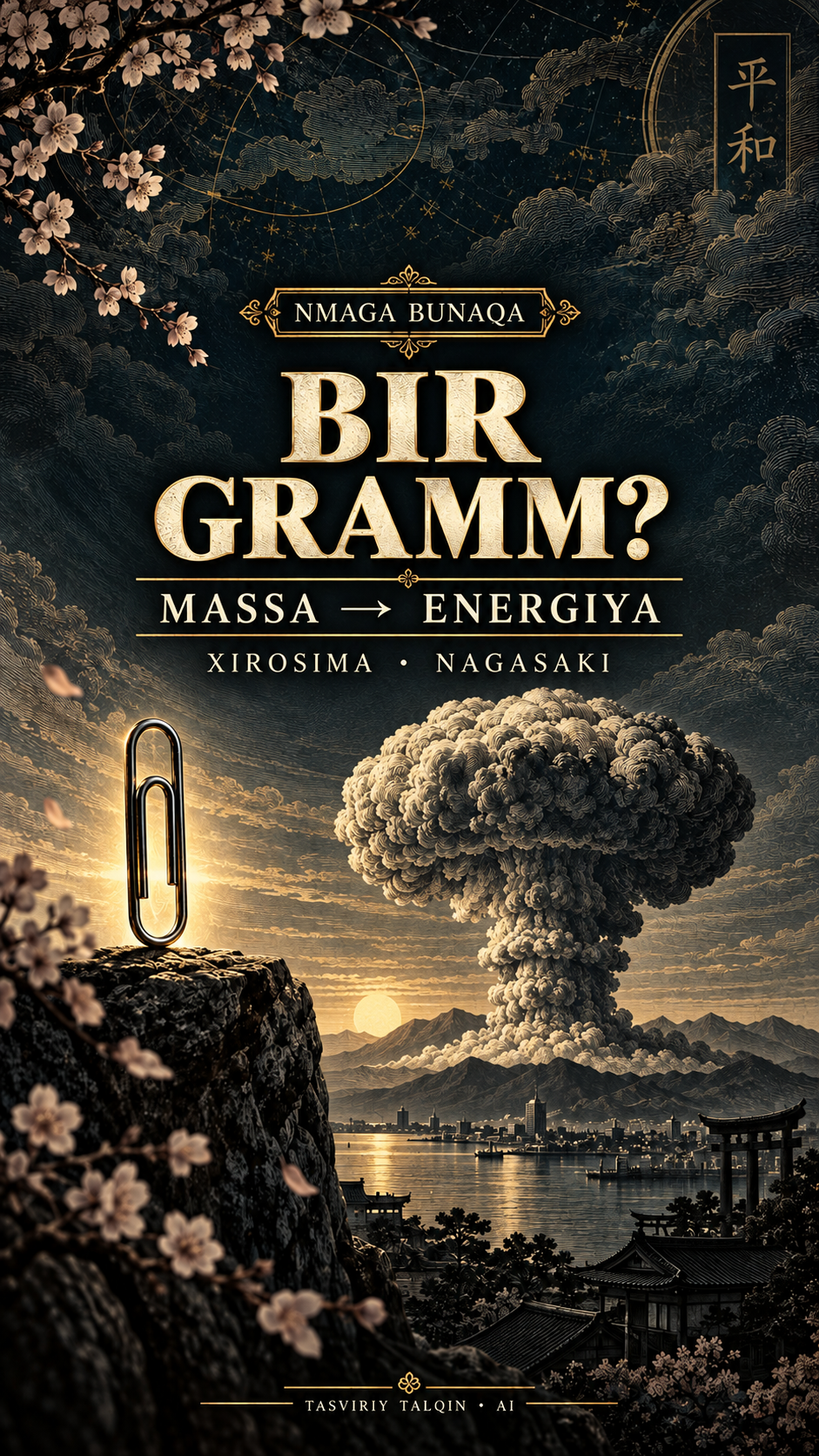
Nagasaki’s estimated yield of about 21 kilotonnes TNT corresponds to ≈0.98 g through E = Δmc². Hiroshima’s 15.25 kilotonnes corresponds to ≈0.71 g, rounded in the film to ≈0.7 g and ≈15,000 tonnes TNT.
This is not the mass of the bomb or its uranium. It is an energy-equivalent mass difference, not a separately weighed loss. The one-gram paper clip is a notional comparison.
The opening footage is Nagasaki
The opening cloud is Nagasaki on 9 August 1945, from the 1946 film Tale of Two Cities. Its B-29 and ruins inserts come from the same film. Author: Army–Navy Screen Magazine / US War Department; scan: A/V Geeks.
It is not labelled as Hiroshima explosion footage. The date rewind is a narrative transition; the opening is slowed to fit narration. The aircraft insert is generic B-29 archive. Original archive sound is muted. The film is marked public domain as a US government work.
The fall and the chain reaction
On 6 August 1945 the bomb was released near 9.5 km, fell for about 43 seconds and exploded near 600 m. It contained 64 kg of uranium. Particles released in fission can cause further nuclei to split.
The 64 tiles illustrate an amount, not the real shape of the fuel. The 1→2→4 tree, particles, trajectory, fireball and sizes are schematic. The film does not say all 64 kg became energy or explain weapon construction.
Damage and human consequences
Hiroshima City states that almost all buildings within two kilometres were destroyed or burned. The city estimates about 140,000 deaths by the end of 1945.
140,000 is an approximate end-of-year estimate, not an instantaneous death toll. The two-kilometre ring on the historical mosaic is approximate, not an exact damage boundary or cadastral measurement.
15 August was the announcement
Japan announced its surrender on 15 August 1945. The formal instrument was signed on 2 September.
Announcement and signing are distinct dates. The film does not attribute surrender solely to the atomic bombs. The radio is an illustration, not the emperor’s original voice.
War ended; arsenals grew
The FAS series distributed by Our World in Data gives a global nuclear-warhead stockpile of 64,452 in 1986. The film says it exceeded 60,000. The UN states there has been no wartime nuclear-weapon use since Nagasaki; checked as of 10 October 2026.
Stockpiles are not explosions or all warheads ever produced. No wartime use does not mean no nuclear tests or no remaining weapons. No current country ranking is shown.
08:15, so we remember
Hiroshima was rebuilt. The Peace Clock Tower sounds daily at 08:15. The real ending photograph is by そらみみ, licensed CC BY-SA 4.0.
The photograph is cropped and framed; its adaptation remains under that licence. The chime is a recreated sound interpretation, not an authentic recording of the tower. The remembrance line is the film’s closing wording.
Images and sound
Hiroshima aerial mosaics dated 13 April and 11 August 1945: USSBS / US National Archives, NARA 540225 and 540226, public domain. Converted to sepia; ring and transitions are schematic. Cinzel, Cormorant and Archivo fonts use open SIL OFL licences.
Cover, drawn city, sky, aircraft, watch, radio and clip are AI illustrations, not historical photographs. Music and aircraft, blast and chime effects are original Nmaga Bunaqa sound interpretations. Synthetic narration is used. The cover’s cloud illustration is not archive footage.
About the materials
Archive film: Army–Navy Screen Magazine / US War Department, Tale of Two Cities (1946); scan by A/V Geeks; public domain. Aerial mosaics: USSBS / NARA 540225 and 540226, public domain.
Peace Clock Tower photograph: そらみみ, CC BY-SA 4.0; cropped and framed, with the adapted photograph retaining the licence. Music and effects: Nmaga Bunaqa. Cover and reconstruction images: AI illustrations.
Found an error?
If you find a specific error or a better source, send us the claim and its link. We will review it and date any correction on this page.
Write to us on Instagram