On this page
Three key points
Meteorological observations in Tashkent began in December 1867.
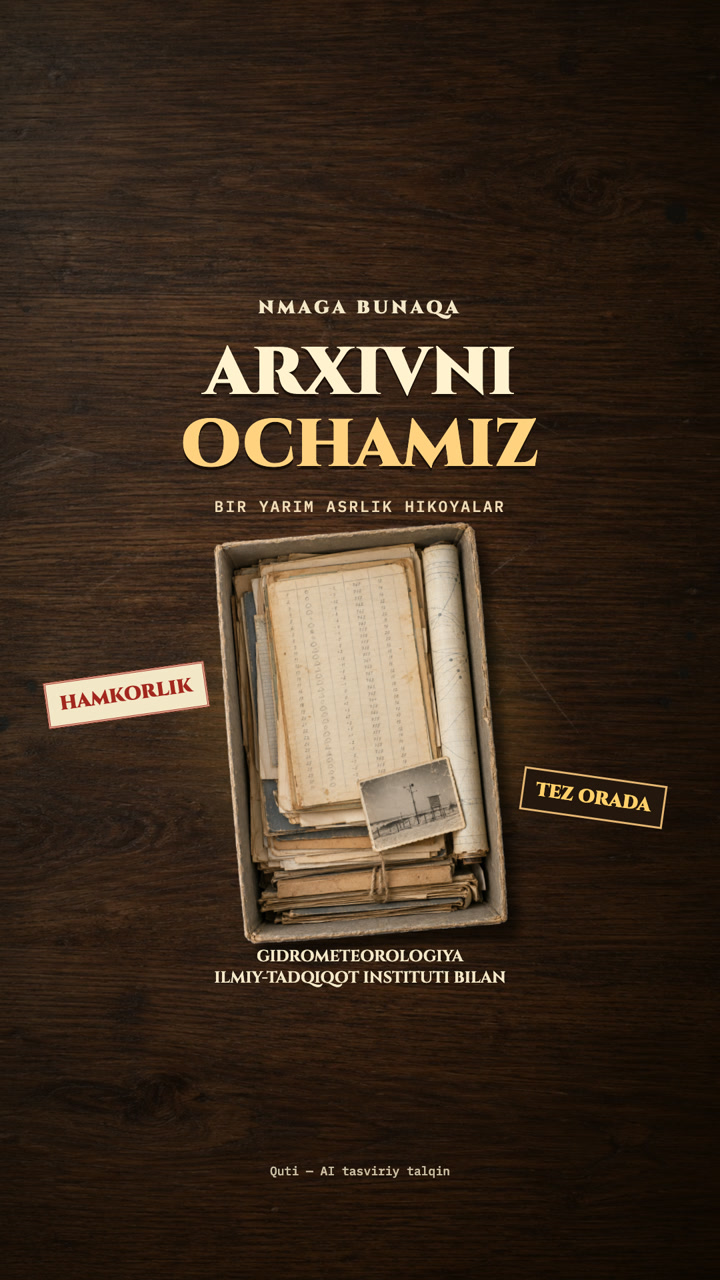
The teaser introduces real books, records and research through an illustrated box.
The partnership turns scientific evidence into understandable stories.
Which century and a half?
Official Uzhydromet history dates meteorological observations in Tashkent to December 1867 and the observatory weather station to September 1876. The Hydrometeorological Research Institute was established in 1957.
These dates refer to three different events. The teaser does not claim uninterrupted daily coverage for 159 years or that all originals are held in one box.
Real historical photographs
The Kukeldash madrasa photograph comes from the Turkestan Album, dated to 1865–72. The observation-grounds photograph is from 1958–59, Tatyana Vavilova’s family archive. The old meteorological-book photograph was supplied by the partner; the upper title page says 1891.
The books are not presented as an original Tashkent observation log; the lower book concerns another station. Moving sky and birds were added to the Kukeldash photograph.
The temperature chart
The annual-mean chart for 1867–2025 was redrawn from 159 values in the partner-supplied workbook. The exact values used are provided in a CSV copy.
Complete station and calculation-method metadata were not supplied. The teaser makes no +5°C, seasonal-change, Egypt-equivalence or local-peak ENSO-attribution claim.
Records on wartime and earthquake dates
Three daily means are shown from station UZM00038457 in NOAA GHCN-Daily: 22 June 1941 — 28.8°C; 9 May 1945 — 20.5°C; 26 April 1966 — 14.8°C.
These are daily averages, not a reading at the instant of the earthquake. The on-screen table is a redrawn reconstruction, not a photograph of an original notebook.
Glacier measurements
The Abramov research station was established in 1967. Its modern satellite image is Sentinel-2 from 2025. The Barqiroq team photograph comes from the institute’s August 2026 field material.
1967 dates the station, not the satellite photograph. The teaser makes no blanket-trial result or whole-glacier melt-volume claim. No unverified names are assigned to pictured people.
Research above the clouds
The film shows the cover and a weather-modification review in the institute journal, 2025 issue 3, printed pages 79–83.
This introduces a research direction; it does not claim guaranteed rain or a demonstrated increase in rainfall. The cover and page come from the retained original journal.
Partnership and visual interpretation
Nmaga Bunaqa introduces stories about observations and research with the Hydrometeorological Research Institute. The channel owner confirmed material reuse permission on 10 October 2026.
The box, its illustrated papers, handshake and cover are AI editorial illustrations, not an official archive container, logo or photograph of a signing event. The music is excerpted, faded and reduced in level.
About the materials
Kukeldash: Turkestan Album / Library of Congress, Wikimedia Commons. Observatory: Tatyana Vavilova family archive / mytashkent.uz. Books and annual table: partner-supplied material. Field photo and journal: Hydrometeorological Research Institute.
Contains modified Copernicus Sentinel data (2025). Box, handshake and cover: AI editorial illustrations. Animation: Nmaga Bunaqa. Cinzel, Cormorant and IBM Plex fonts: SIL OFL.
Unanswered Questions by Kevin MacLeod (incompetech.com). Licensed under Creative Commons: By Attribution 4.0. https://creativecommons.org/licenses/by/4.0/
Music
Found an error?
If you find a specific error or a better source, send us the claim and its link. We will review it and date any correction on this page.
Write to us on Instagram