On this page
Three key points
Empire was built through alliances, lineage, the army and people’s loyalties.
Victory, the suffering of cities and Samarqand’s construction belong to one history.
Disputed legends, schematic maps and AI illustrations are distinguished from historical evidence.
The film opens with Bayezid’s capture, then returns to Kesh. It follows how power was assembled and sustained through people’s loyalties.
Captivity is historical. The iron-cage story is disputed; the film does not present it as established fact.
By tradition, Amir Temur was born near Kesh in 1336. His father Taraghay was a Barlas amir. Where the right to be khan was tied to Chinggis Khan’s line, that background alone did not confer supreme authority.
The birth date is presented as traditional. Amirship, khanship and kinship are different titles and relationships.
The alliance with Husayn was reinforced by marriage. An injury in these years left lasting damage to Amir Temur’s right arm and leg. Defeat at the Battle of the Mire in 1365 shows the difficult road before later victories.
The injury is usually associated with Sistan; details vary. The battle scene and rain are interpretive illustrations, not a measured reconstruction.
After Husayn’s surrender in 1370, Amir Temur’s supreme authority was recognised. A Chinggisid khan occupied the throne while the amir retained real power. Marriage to Saray Mulk Khanum and the title Güregen, “the khan’s son-in-law”, strengthened this arrangement.
Accounts of Husayn’s death differ. Museum coins document examples bearing both names; this is not a claim about every coin issue.
The army used decimal organisation; supply and obedience mattered during campaigns. Princes governed provinces in the ruler’s name. Isfahan shows the severe consequences of expansion for civilians.
The film dates the Isfahan revolt and mass deaths to 1387; Roemer uses 1388. Conflicting casualty totals are not repeated. Building achievements do not erase violence.
Tokhtamysh, once helped by Amir Temur, became his rival. The sack of Tabriz, the threat to Transoxiana and the Kondurcha campaign of 1391 trace the break. The blow at the Terek in 1395 also reached cities and trade routes.
Victory at Kondurcha did not capture Tokhtamysh. Map colours and the route are schematic; the Karsakpay inscription does not authenticate every animated detail.
In the 1398 campaign, elephants threatened cavalry. Yazdi describes a ditch, barriers and iron caltrops, fighting on the right wing, then the sack of the city and the removal of craftsmen.
Yazdi was a Timurid court historian. His explanation of the sack as soldiers’ disorder is an author’s framing. Obstacle placement and the two-sided attack choreography are schematic. Delhi is not shown as becoming a permanently governed Timurid province.
Anatolian beys and protection of rival rulers helped bring the two powers into conflict. Ibn Khaldun recorded the meeting at Damascus in 1401. The detour to Ankara, Bayezid’s return and changes of allegiance underpin the battle explanation.
Bayezid died in captivity in 1403; the Ottoman succession struggle lasted from 1402 to 1413. Troop numbers and exact positions are not presented as recovered evidence. The disputed cage story is distinct from captivity itself.
Clavijo observed craftsmen and building works in Samarqand in 1404. These sources cover the rebuilt Bibi Khanum gateway, Amir Temur being carried to the work in a litter, and the mausoleum built for Muhammad Sultan.
The relocation of craftsmen is not presented simply as celebration or voluntary travel. Amir Temur was first buried beside Muhammad Sultan, then moved to his present resting place around 1409. Modern photographs do not reproduce the fifteenth-century appearance.
The late-1404 expedition was directed towards China. Amir Temur fell ill at Otrar and named Pir Muhammad as heir. He died on 18 February 1405; the expedition was abandoned.
The miniature of 1436 is a later illustration. It is neither direct proof that the will was carried out nor an exact record of the 1405 event. The route arrow does not imply a completed conquest of China.
Khalil Sultan took Samarqand; Shahrukh rebuilt power from Herat. Pir Muhammad was killed in 1407. Shahrukh entered Samarqand in 1409 and left it to Ulugh Beg. The ending looks towards Babur and Panipat in 1526.
Successor colours and changing territories are a simplified political diagram. The closing question about loyalty is the film’s interpretation, not a historical figure’s verbatim quotation.
Maps and illustrative interpretation
Terrain uses NOAA ETOPO 2022 and coastlines use Natural Earth. Movement, territory colours, troops, portraits and staged paintings explain the story.
Political boundaries, routes and battle positions are approximate. Modern terrain does not fully document medieval waterways. AI portraits are not authentic likenesses or historical photographs.
Archival images: source and date
Below are the miniatures, photographs, coins and museum records indexed in the published source comment. Fifteenth-century Zafarnama illustrations, later art and modern photographs provide different kinds of evidence.
Miniatures of 1436 and 1467 postdate the events they depict. Images were cropped, scaled and colour-adjusted. CC BY-SA material and the CC0 photograph are identified separately; portraits are not treated as authenticated likenesses.
The published source comment
This page matches the source package for the 18:38 film published on YouTube on 3 October 2026. Chapter times help readers navigate between the film and its evidence.
Links lead to original texts, translations, museum catalogues or scholarly interpretation. Court historians are not assumed to be impartial. Independent historian or full native-language certification of every translation is not claimed.
About the materials
Historical images are recorded as public domain in the source package. M.samei (coin), Francesco Bini (dirham), LBM1948 (Gur-e Amir) and Coopypasted (Otrar): CC BY-SA 4.0. Bgag’s photograph of the Ulugh Beg Observatory exterior: CC0. Links are in the archive section.
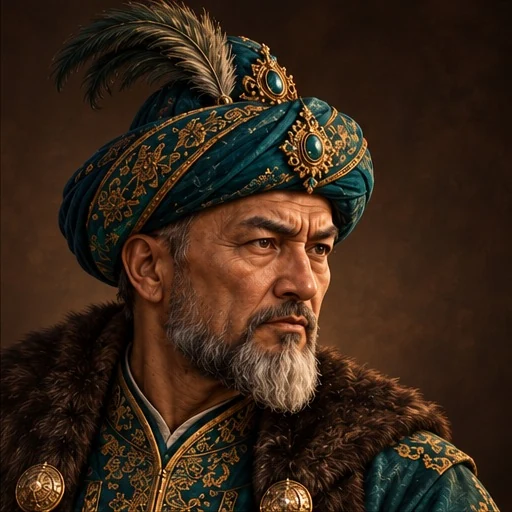
Portraits, including this page’s cover, and staged paintings: AI-assisted illustrative interpretations. Original characters, map animation and mehter march: Nmaga Bunaqa. Narration: Liam / ElevenLabs, synthetic voice.
Music: Kevin MacLeod (incompetech.com), Creative Commons Attribution 4.0. Ancient Rite; Anguish; Clash Defiant; Crusade — Heavy Industry; Dark Times; Desert City; Five Armies; Heartbreaking; Hero Down; Ibn Al-Noor; Lasting Hope; Long Road Ahead B; Lord of the Land; Unanswered Questions; Volatile Reaction. Music was edited and mixed to picture.
Music
Found an error?
If you find a specific error or a better source, send us the claim and its link. We will review it and date any correction on this page.
Write to us on Instagram