On this page
Three key points
Five banking houses formed a nineteenth-century network.
≈44% refers to Suez company shares.
Influence does not establish unlimited control.
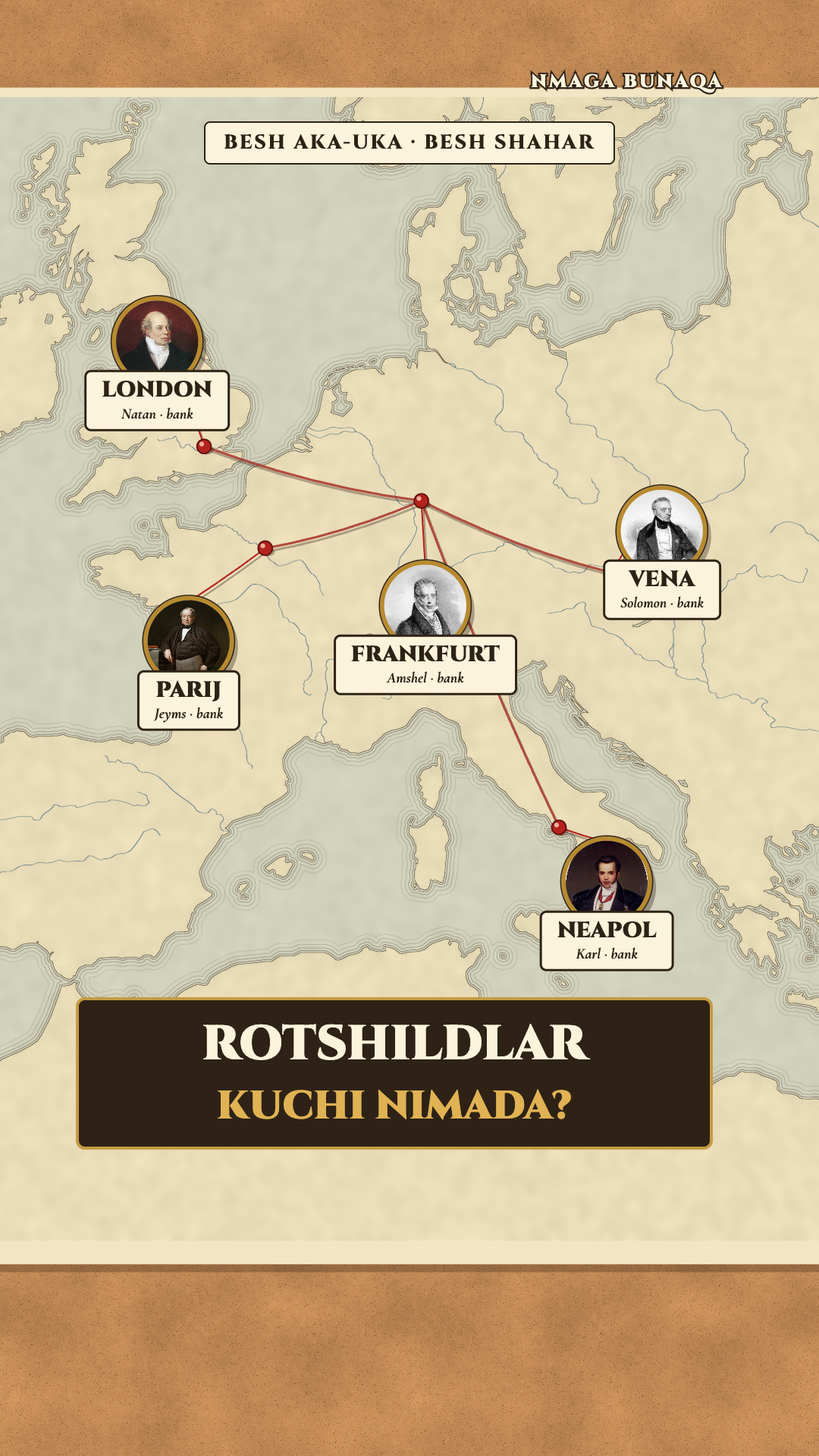
Five brothers, five banking cities
Frankfurt, London, Paris, Vienna and Naples formed a nineteenth-century network; the five houses existed by 1821. The opening is an overview. Mayer’s coin dealing and financial services are documented in the family archive biography.
The map, threads and moving symbols are schematic. This does not mean all five banks existed in 1814. The family archive is identified as the source of its own institutional history.
Letters and information
An 1816 letter illustrates daily business, price and family communication in German written with Hebrew characters. The network supported information exchange.
This was not a separate cipher. The animated envelope is not a facsimile; faster communication does not mean perfect or universal knowledge.
Gold for the British army, 1814–1815
On a British government commission, gold was purchased and delivered for Wellington’s army. This was documented government business supported by an international network.
The drawn route is not an archival itinerary. The film distinguishes this work from a miraculous one-day fortune in 1815.
1875: finance, company shares and fees
Britain acquired the Khedive’s 176,602 shares. Out of 400,000 this is 44.1505%, rounded to ≈44% on screen. Lionel’s London bank provided about £4 million of finance. The 1876 parliamentary debate records a 2.5% commission and 5% annual interest terms.
The percentage concerns company shares, not canal length or Egyptian territory; voting power was not proportional to the shareholding. Financing does not establish that the bank made the government’s political decision. Critics’ annualised figures are not presented as contractual rates.
The 1917 letter: author and recipient
On 2 November 1917 Arthur James Balfour wrote on behalf of the British government to Lord Walter Rothschild, asking him to communicate the declaration to the Zionist Federation. Support for a national home for the Jewish people in Palestine was a government statement.
The original also protects the civil and religious rights of existing non-Jewish communities and the rights and political status of Jews elsewhere. Receiving a letter does not establish authorship or control over government.
Waterloo: the famous story and the records
Brian Cathcart examined contemporary letters, market reports and newspapers. A hostile 1846 pamphlet spread the famous one-day-fortune version, 31 years after the battle. Later pigeon post is documented; pigeon delivery of the victory news in 1815 is not authenticated.
A 31-year delay alone does not prove falsehood: the contemporary evidence matters. The film does not deny every possible profit in 1815. Cathcart’s study is identified as published by the family archive.
Influence is not unlimited control
Government finance, trade and political contacts can be examined historically. These documents do not establish a claim of control over the entire world. No present-day total family fortune is calculated.
This is a film about specific family businesses, not a collective accusation against a people or religion. Source provenance and documentary scope are retained. Five arrows are a historic heraldic symbol; the modern arms SVG is not used in the film.
Historical images and map credits
The used Mayer, five-brother, Lionel, Ismail and Balfour-letter files are linked below: public-domain historical images, cropped, framed and animated. Some Mayer/Nathan/Lionel images are works by Moritz Daniel Oppenheim. The letter is a UK Government / British Library reproduction.
The court scene is a later historical interpretation, not a photograph of the event. Map: Natural Earth; routes are schematic. Envelopes, arrows, gold, soldiers, pigeon and Suez view are artistic AI-assisted interpretations, not documentary footage. The cover uses the film’s map and historical portraits.
Music, narrator and fonts
Music: “Investigations” — Kevin MacLeod (incompetech.com), Creative Commons By Attribution 4.0; edited, faded and reduced beneath narration. Synthetic narration is used.
Effects are not historical recordings. Cinzel and Cormorant use SIL Open Font License; the shared closing uses Arial.
About the materials
The used Mayer, five-brother, Lionel, Ismail and Balfour-letter files are linked below: public-domain historical images, cropped, framed and animated. Some Mayer/Nathan/Lionel images are works by Moritz Daniel Oppenheim. The letter is a UK Government / British Library reproduction.
The court scene is a later historical interpretation, not a photograph of the event. Map: Natural Earth; routes are schematic. Envelopes, arrows, gold, soldiers, pigeon and Suez view are artistic AI-assisted interpretations, not documentary footage. The cover uses the film’s map and historical portraits.
Music: “Investigations” — Kevin MacLeod (incompetech.com), Creative Commons By Attribution 4.0; edited, faded and reduced beneath narration. Synthetic narration is used.
Effects are not historical recordings. Cinzel and Cormorant use SIL Open Font License; the shared closing uses Arial.
Found an error?
If you find a specific error or a better source, send us the claim and its link. We will review it and date any correction on this page.
Write to us on Instagram