On this page
Three key points
25 to 22 are values reported by al-Umari.
Twelve years is not an exact recovery period.
Richest ever is not an established comparable ranking.
25 to 22: al-Umari’s account
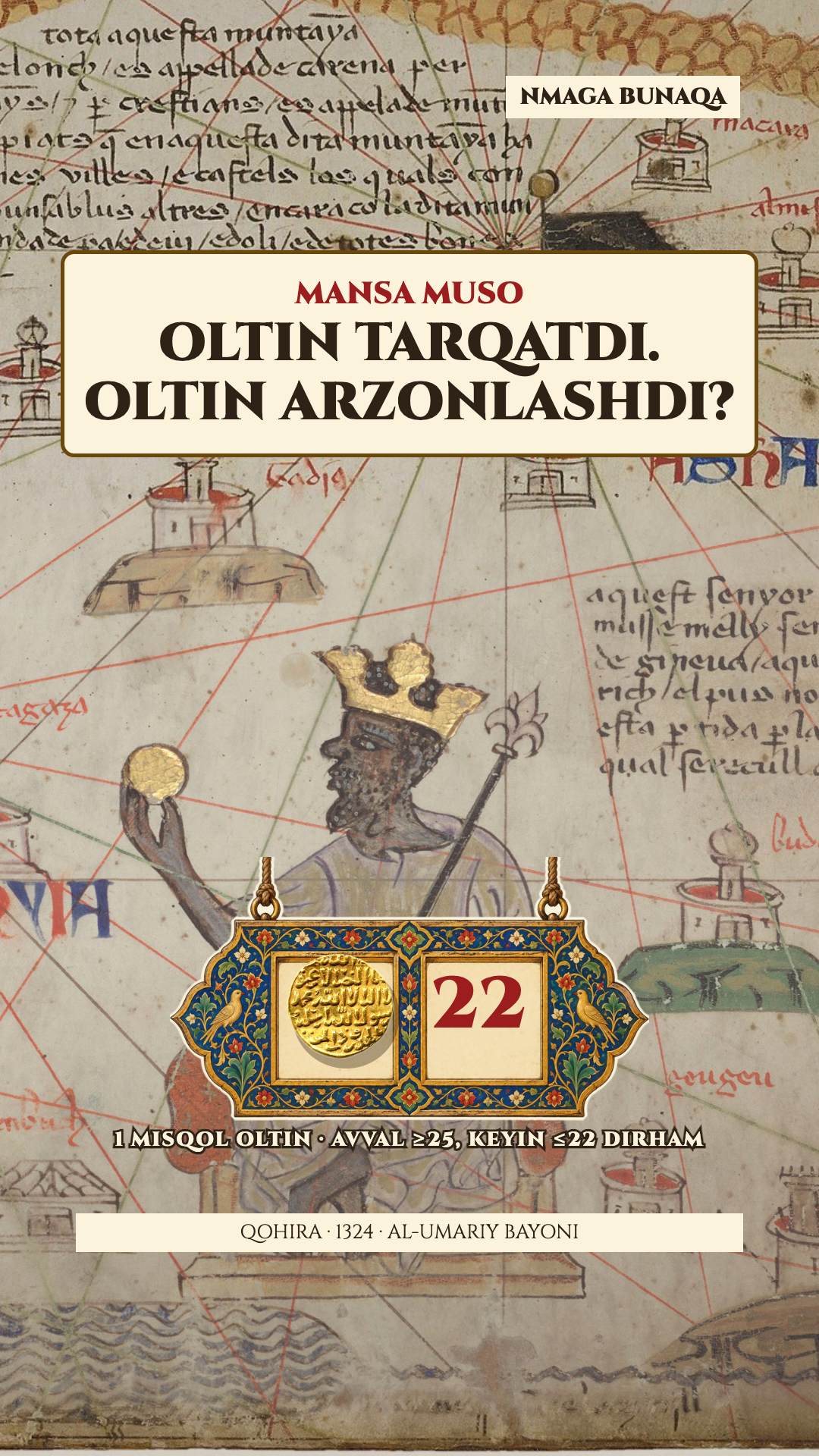
Al-Umari’s account of gold distribution in Cairo during the 1324 pilgrimage reports at least 25 silver dirhams per mithqal before, then 22 or less. He later collected local testimony.
These are attributed reports, not an independent daily market series. The film does not claim an economic collapse or sole causation by Musa.
Twelve years is not a recovery date
The account describes the price as still low about twelve years later.
The film does not claim a return to the earlier price in year twelve or establish an exact recovery date.
The atlas ruler and the richest-ever question
The Catalan Atlas, conventionally dated around 1375, depicts Mali’s ruler holding gold. It records a medieval representation of wealth.
A regional description is not a comparable ranking of all people across history. No modern-dollar fortune or verified richest-ever verdict is given.
The borrowing account attributed to Ibn Battuta
A translated account quoting Ibn Battuta reports Musa borrowing in Egypt.
The film asserts no loan amount, exact repayment date or direct causal link from the gold-price fall.
The economic scale is an illustration
If gold becomes more abundant while goods stay unchanged, the same item may require more gold. Bread, cloth and the scale illustrate that conditional example.
No historical Cairo bread or cloth census was measured. The scale does not show equal coin masses, a daily price series or depreciation of every currency.
Djingareyber: foundation and later rebuilding
UNESCO associates the initial construction with Musa’s return from pilgrimage; it was rebuilt and enlarged in 1570–1583. The film uses a photograph taken in 2020.
The roughly 700-year story refers to elapsed history: 2026−1324=702. It does not imply unchanged masonry or a photograph taken today.
Image authors and modifications
Atlas: attributed to Abraham Cresques, about 1375; BnF Espagnol 30, public-domain reproduction, cropped and animated. Coin photographs: American Numismatic Society, CC0. Mosque: Dr. Ondřej Havelka, 24 January 2020, CC BY-SA 4.0; cropped, resized and panned; the adapted photograph remains under that licence.
The coins illustrate the period: gold 1340, silver 1290, not coins identified as Musa’s. Drawn caravan, Cairo, people and market are artistic AI interpretations. The map route is schematic, not a surveyed itinerary.
Music, voice and fonts
Music: Desert City — Kevin MacLeod (incompetech.com), Creative Commons By Attribution 4.0; edited, faded and reduced under narration. Synthetic narration is used. Effects are not historical recordings.
Cinzel and Cormorant use the SIL Open Font License. The cover board illustrates al-Umari’s reported values, not a measured modern price series.
About the materials
Atlas: attributed to Abraham Cresques, about 1375; BnF Espagnol 30, public-domain reproduction, cropped and animated. Coin photographs: American Numismatic Society, CC0. Mosque: Dr. Ondřej Havelka, 24 January 2020, CC BY-SA 4.0; cropped, resized and panned; the adapted photograph remains under that licence.
The coins illustrate the period: gold 1340, silver 1290, not coins identified as Musa’s. Drawn caravan, Cairo, people and market are artistic AI interpretations. The map route is schematic, not a surveyed itinerary.
Music: Desert City — Kevin MacLeod (incompetech.com), Creative Commons By Attribution 4.0; edited, faded and reduced under narration. Synthetic narration is used. Effects are not historical recordings.
Cinzel and Cormorant use the SIL Open Font License. The cover board illustrates al-Umari’s reported values, not a measured modern price series.
Found an error?
If you find a specific error or a better source, send us the claim and its link. We will review it and date any correction on this page.
Write to us on Instagram