On this page
Three key points
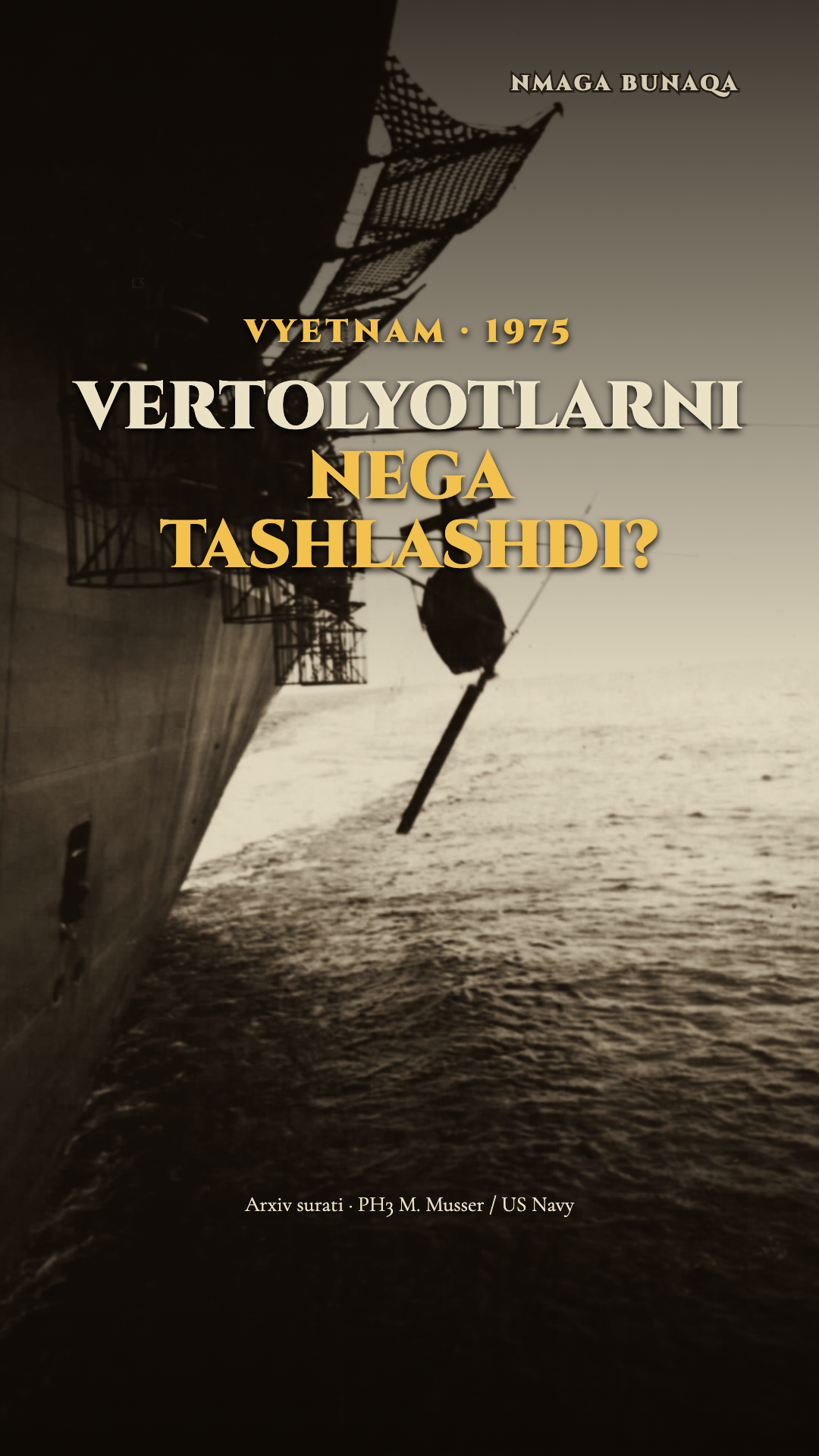
The opening combines archive stills from different ships.
The Ho Chi Minh Trail was a repairable supply network.
The 1973 US withdrawal did not end the war.
Helicopters and a family of seven
During the April 1975 evacuation, helicopters were pushed overboard to clear landing space on US ships. Major Buang Ly, his wife and five children landed a Cessna O-1 on USS Midway.
The opening combines stills from USS Okinawa and USS Blue Ridge, not continuous footage of one helicopter. The Midway family is a separate episode. The note is retyped and its translated excerpt shortened. Catalogue dates differ, so the film uses April 1975.
The 1954 line and the US objective
Vietnam was temporarily divided in 1954. The United States sought to preserve the southern government; the North and Viet Cong sought reunification under communist rule. US military personnel in Vietnam peaked at 543,000 in April 1969.
The 17th parallel was not intended as a permanent international border. Over half a million refers to personnel present at the 1969 peak, not everyone who served throughout the war.
External support and a supply network
The Soviet Union and China supported North Vietnam. The Ho Chi Minh Trail was a network of roads, storage sites and bypasses through Laos and Cambodia. Damaged sections were repaired; cargo bicycles were also used.
The day/night dial schematically illustrates repeated attack and repair, not a universal timetable. Air attacks also occurred at night; not every damaged section reopened overnight. Simplified routes and moving cargo symbols do not imply uninterrupted supply.
The 1967 statement and Tet
Late in 1967, Westmoreland presented an optimistic account of progress. The late-January 1968 Tet attacks struck over a hundred cities and towns; attackers breached the US embassy compound wall in Saigon. The attacks were repelled militarily but weakened confidence in an early end to the war.
Entering the grounds does not mean capturing the embassy building. Antiwar opinion predated Tet. Tet was neither the sole cause nor an instant US military defeat. Map dots do not locate every attack precisely.
Kissinger’s 1969 assessment
Henry A. Kissinger, “The Viet Nam Negotiations”, Foreign Affairs, January 1969, pages 211–234; the cited sentence appears on page 214. The film displays the English sentence and a concise Uzbek translation.
This is Kissinger’s contemporary assessment, not a universal law or a complete explanation of the conflict. The panel is retyped, not presented as a photograph of the original.
1973, 1975 and the scope of losses
US combat forces withdrew after the 1973 agreement, but the war continued. North Vietnam’s regular army took Saigon on 30 April 1975. The NARA extract records 58,220 US military fatalities; the film rounds this to about 58,000.
Millions of regional deaths include civilians and military personnel in Vietnam, Laos and Cambodia; estimates and periods vary. This is not the same category as US military fatalities. The 1975 map does not date formal state unification, which occurred in 1976. This short film explains selected factors, not the entire war.
Archive photographs and film credits
US Navy, USMC, USAF and US Army archive works are US Government public-domain material. PH3 M. Musser made the Blue Ridge photos; SP6 Samuel L. Swain made the embassy-wall photo. The non-graphic Tet APC excerpt is US Army, NARA ARC 31793 / 111-LC-52554.
Photos are cropped, resized, graded and animated with pan/zoom. Gabichan2020’s bicycle photo uses CC BY-SA 4.0; adapted photo material retains that licence, not automatically the entire film.
Maps, music and production
Natural Earth boundaries and rivers and NOAA ETOPO relief are public domain. Historical lines, routes, attack dots and advances on modern geometry are schematic. Synthetic narration is used; effects are sound design, not original battle or archive recordings.
Music: Long Road Ahead B and Heartbreaking by Kevin MacLeod (incompetech.com), CC BY 4.0; shortened, ducked and faded. Cinzel, Cormorant, Special Elite and IBM Plex Mono use SIL Open Font License. The cover combines a real archive photograph with graphic design.
About the materials
US Navy, USMC, USAF and US Army archive works are US Government public-domain material. PH3 M. Musser made the Blue Ridge photos; SP6 Samuel L. Swain made the embassy-wall photo. The non-graphic Tet APC excerpt is US Army, NARA ARC 31793 / 111-LC-52554.
Photos are cropped, resized, graded and animated with pan/zoom. Gabichan2020’s bicycle photo uses CC BY-SA 4.0; adapted photo material retains that licence, not automatically the entire film.
Natural Earth boundaries and rivers and NOAA ETOPO relief are public domain. Historical lines, routes, attack dots and advances on modern geometry are schematic. Synthetic narration is used; effects are sound design, not original battle or archive recordings.
Music: Long Road Ahead B and Heartbreaking by Kevin MacLeod (incompetech.com), CC BY 4.0; shortened, ducked and faded. Cinzel, Cormorant, Special Elite and IBM Plex Mono use SIL Open Font License. The cover combines a real archive photograph with graphic design.
Music
Found an error?
If you find a specific error or a better source, send us the claim and its link. We will review it and date any correction on this page.
Write to us on Instagram