
On this page
Three key points
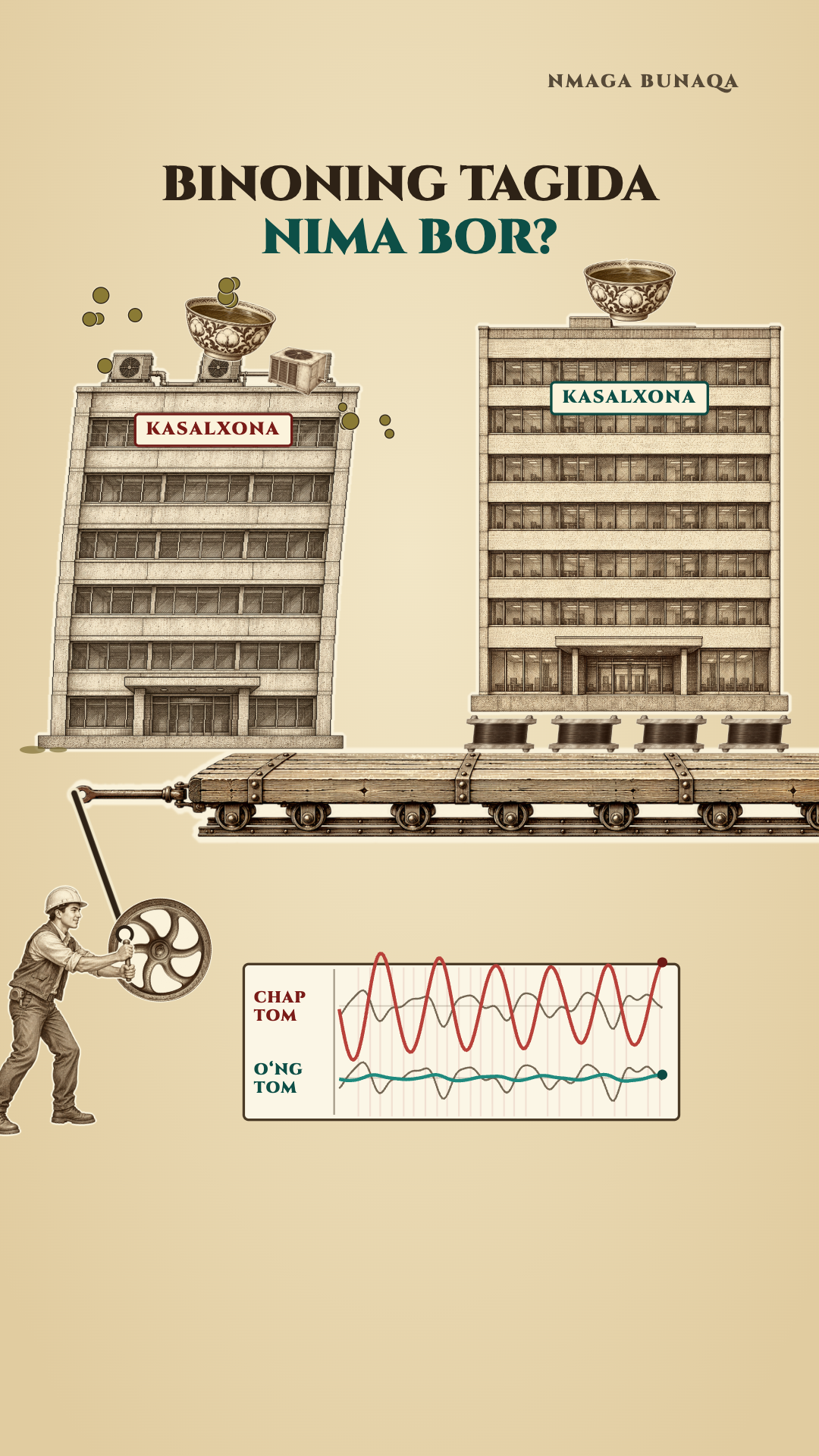
The tea table is a schematic common-input test.
Ground shaking differed at the real hospital sites.
149 bearings; 10% means lateral capacity used in that event.
One test, two responses
The buildings, tea and shake table illustrate the isolation principle qualitatively. Laminated steel-rubber bearings support vertical loads while deforming sideways.
The animated displacements are not measurements or scaled from acceleration ratios. They do not guarantee zero damage for every building.
1994: two real hospitals
The 17 January 1994 Northridge earthquake near Los Angeles had magnitude 6.7. Instruments recorded ground and roof motion at Olive View and USC. The map is redrawn from the USGS ShakeMap grid.
Ground shaking differed between the sites, about 15–16 km and 35 km from the epicentre. Each actual roof response is compared with its own local ground.
Olive View: standing versus operating
Peak roof acceleration of 2.31 g divided by free-field 0.91 g is ≈2.5. Structural performance was good, but equipment and pipe damage temporarily interrupted hospital service.
This is the new building in 1994, not the old hospital damaged in 1971. No collapse is claimed. Equipment and water scenes are schematic reconstructions of documented damage.
USC: 149 bearings and recorded response
USC hospital rested on 149 isolators. USGS describes peak roof acceleration as about 40% of the nearby ground record; the building and contents suffered no damage.
The film trace is digitised and redrawn from a printed USGS FS 068-03 figure, not a raw accelerometer file. The nearby ground record was about 60 m from the building.
What does ten percent mean?
Approximately 10% of the isolators’ lateral displacement capability was used in that 1994 event, for this particular instrumented building.
Ten percent is neither an overall protection rate nor a forecast. Bearing layers and enlarged joint movements illustrate the mechanism schematically.
Limits of the Uzbekistan requirement
Resolution PQ-161 (17 April 2024), item 1, establishes design with active seismic protection, including isolation and dampers, from 1 June 2024 for newly planned medical facilities above five storeys in MSK-64 intensity 8+ zones.
It also covers other buildings above nine storeys; the film focuses on medical facilities. It does not mean every building has the pictured rubber bearings. This is an explainer, not engineering or emergency advice.
Images, music and fonts
Olive View Medical Center, 2023 — Ponderosapine210, Wikimedia Commons, CC BY-SA 4.0; cropped, resized and framed. Adapted photo material retains that licence. USGS hospital/laboratory photographs and NIST reports are US Government works, public domain.
Music: Investigations by Kevin MacLeod (incompetech.com), CC BY 4.0; shortened and ducked beneath speech. Engraved characters and cover are AI illustrations; Synthetic narration is used. Effects are sound design, not an original earthquake recording. Cinzel and Cormorant use SIL OFL; closing uses Arial.
About the materials
Olive View Medical Center, 2023 — Ponderosapine210, Wikimedia Commons, CC BY-SA 4.0; cropped, resized and framed. Adapted photo material retains that licence. USGS hospital/laboratory photographs and NIST reports are US Government works, public domain.
Music: Investigations by Kevin MacLeod (incompetech.com), CC BY 4.0; shortened and ducked beneath speech. Engraved characters and cover are AI illustrations; Synthetic narration is used. Effects are sound design, not an original earthquake recording. Cinzel and Cormorant use SIL OFL; closing uses Arial.
Music
Found an error?
If you find a specific error or a better source, send us the claim and its link. We will review it and date any correction on this page.
Write to us on Instagram