On this page
Three key points
24 years refers to the two-wing arrangement; Pakistan continued.
Language, representation and war form one explanatory chain.
Distances are calculations, battles schematic, death toll disputed.
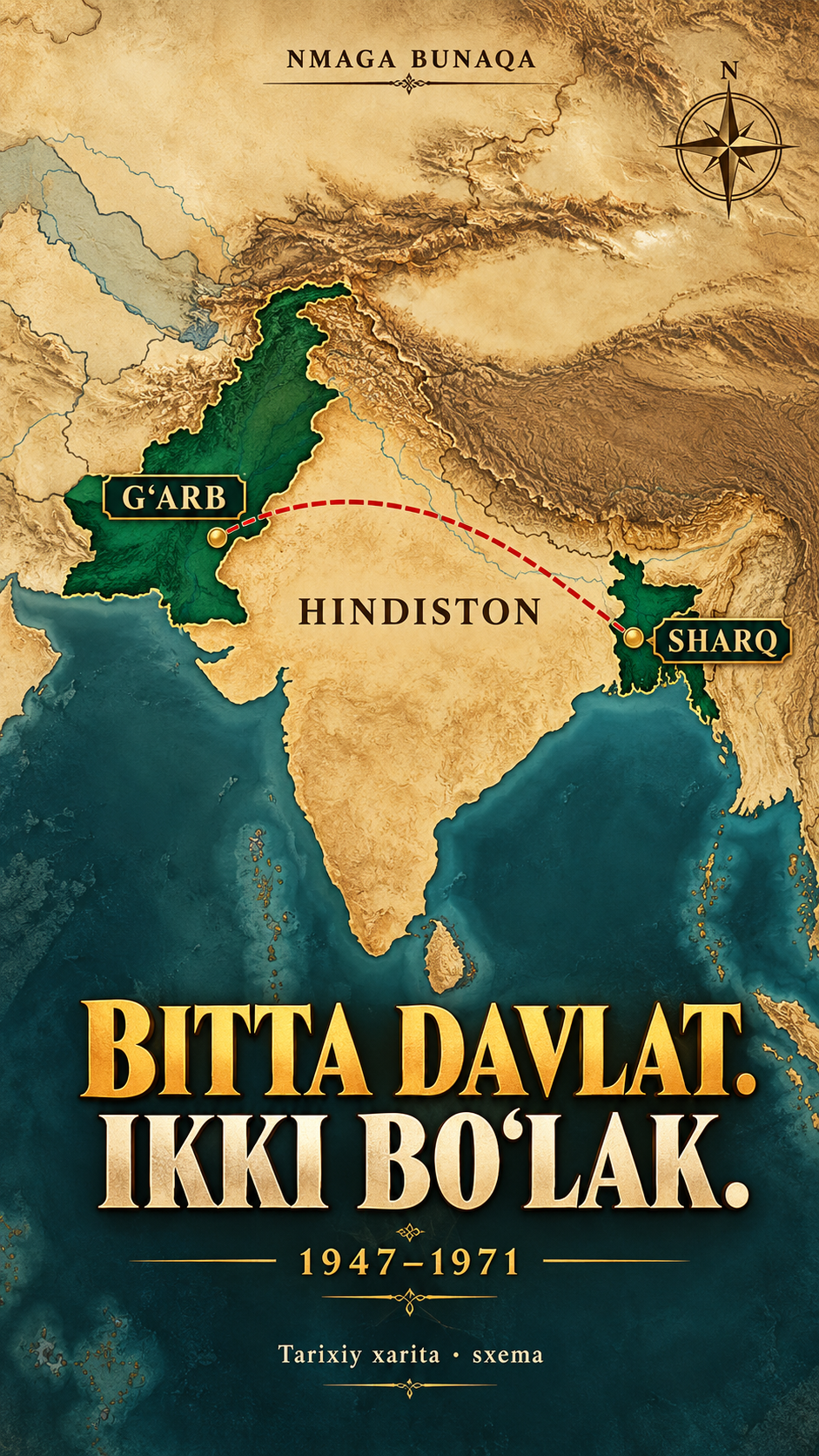
1947–1971: two separated wings
Partition created Pakistan with western and eastern wings separated by India. The eastern wing became Bangladesh in 1971.
The 24 years refer to this two-wing arrangement, not the end of Pakistan. Historical map schematic; Kashmir is disputed.
What does 1,410 km measure?
Our great-circle calculation between the nearest boundary points, excluding Kashmir, is about 1,410 km. Uzbekistan’s longest outline span is about 1,465 km.
Not a road, flight or Karachi–Dhaka distance. Simplified historical boundaries; roughly ±10 km map uncertainty. Uzbekistan is rotated for scale comparison.
People in the east, institutions in the west
Pakistan’s statistics bureau reports about 93 million people in 1961: 50 million east and 42.9 million west, rounded to 50 and 43 in the film.
Historical census, not current population. The capital and army headquarters were in the western wing.
Language and 21 February
The demand for Urdu alone as the state language intensified the Bengali language movement. Police killed demonstrators in Dhaka on 21 February 1952.
The film describes a political demand. Bengali later became a state language alongside Urdu under the 1956 Constitution. The placard drawing is reconstructed.
The 1965 war, Tashkent and Six Points
The Tashkent Declaration was signed on 10 January 1966 after the 1965 war. A subsequent Lahore opposition meeting discussing it became the setting for the autonomy programme.
“Undefended” expresses eastern concern, not zero troops. The Six Points were not signed in Tashkent; the screen paraphrases them.
The 1970 vote: 160 of 300
The Awami League won 160 of the National Assembly’s 300 general seats. The session planned for March 1971 was postponed.
The 300 excludes reserved women’s seats; the total was 313. The narration refers to the stalled transfer of power in that period.
War and displacement in 1971
Armed liberation war followed the March crackdown and independence declaration. A December 1971 US memorandum records nearly ten million refugees in India.
The death toll is disputed. “Hundreds of thousands” is a rounded historical estimate, not a verified individual count. Battle and control-area graphics are schematic.
3–16 December and about 93,000
Pakistan struck Indian airfields on 3 December as full interstate war began. The surrender instrument was signed in Dhaka on 16 December.
About 93,000 includes prisoners of war and civilian internees across the eastern theatre, not soldiers all captured at once in Dhaka. The under-two-weeks phrase describes 3–16 December, not the whole liberation war.
Why is 21 February marked worldwide?
At Bangladesh’s initiative, UNESCO proclaimed International Mother Language Day in 1999. It has been observed since 2000.
The ending connects history with respect for language. The seven language cards are examples, not a complete list.
Photographs and archive credits
1952 procession photographs: Prof. Rafiqul Islam, CC BY 3.0 on Commons; cropped and framed. Surrender photo: Indian Navy, GODL-India. Refugee and check-post footage: NARA ARC 1693134.
The women’s procession filename says 1953, while its description/date say 1952; the film follows the description. That catalogue inconsistency is disclosed. Sound design is not presented as original archive audio.
Maps, music and illustrations
Relief: NOAA ETOPO; geometry: Natural Earth. Drawn people, objects and cover are AI-assisted; Synthetic narration is used. “Desert City” and “Heartbreaking” by Kevin MacLeod (incompetech.com), CC BY 4.0; edited and lowered beneath narration.
Fronts, thread, cracks and control areas are explanatory schematics. Fonts use SIL Open Font License. This is not a current-border or operational military map.
About the materials
1952 procession photographs: Prof. Rafiqul Islam, CC BY 3.0 on Commons; cropped and framed. Surrender photo: Indian Navy, GODL-India. Refugee and check-post footage: NARA ARC 1693134.
Relief: NOAA ETOPO; geometry: Natural Earth. Drawn people, objects and cover are AI-assisted; Synthetic narration is used. “Desert City” and “Heartbreaking” by Kevin MacLeod (incompetech.com), CC BY 4.0; edited and lowered beneath narration.
Music
Found an error?
If you find a specific error or a better source, send us the claim and its link. We will review it and date any correction on this page.
Write to us on Instagram