On this page
Three key points
Terraces and mulch help retain cool-season rainfall in soil.
6.1% and 12.7% are soil moisture for one date and depth, not water consumption.
These results concern a historical experiment, not a guarantee for every orchard.
How is rain retained in soil?
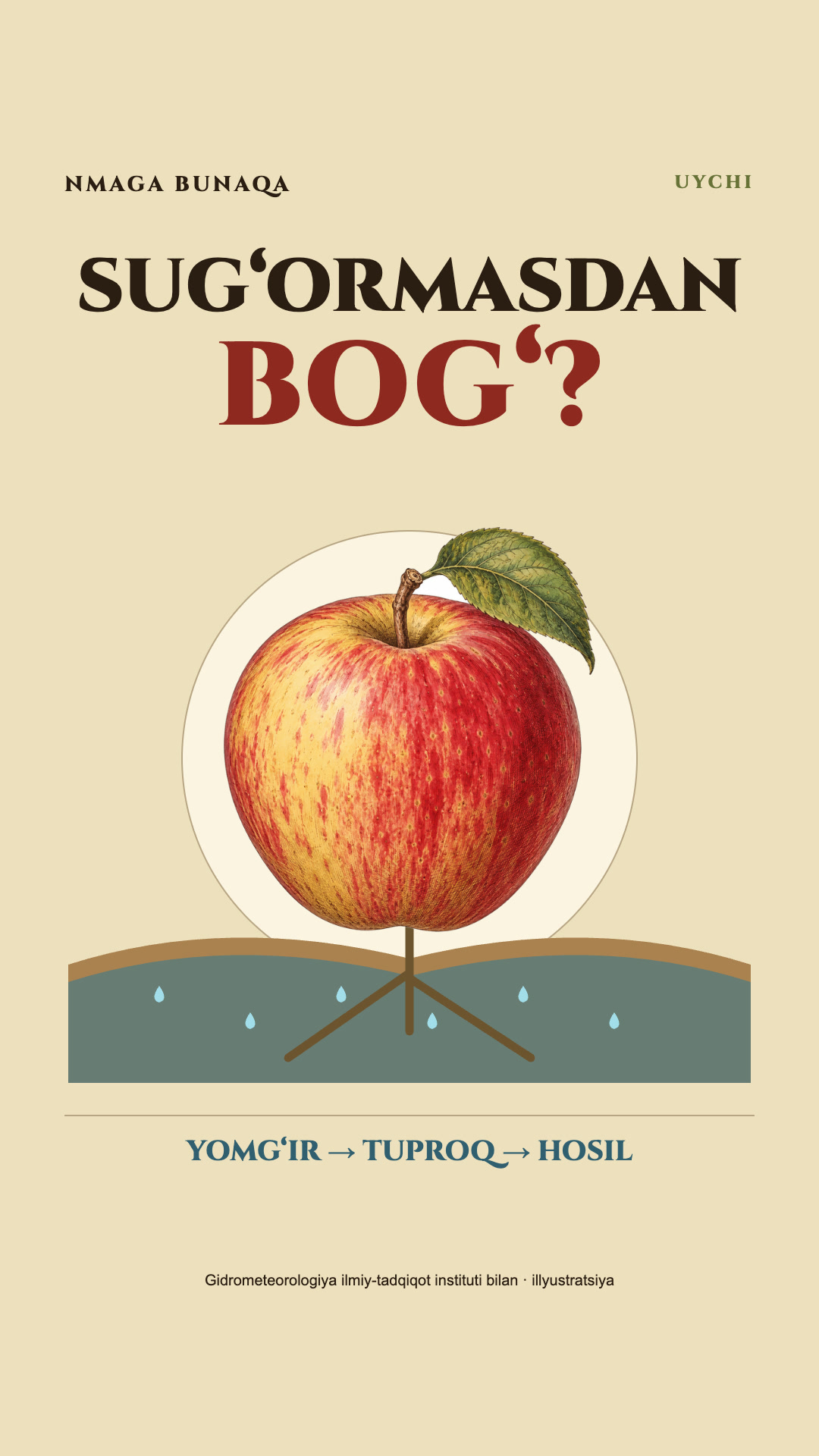
A rain-fed orchard experiment ran in the Uychi hills, Namangan, during 2013–2019. Terraces slow runoff; plastic, organic mulch and a thin soil layer help retain moisture.
This historical experiment is not a guarantee that irrigation can be eliminated everywhere. Watering at planting and the orchard’s current condition are not established; the film makes no claim about either.
6.1% → 12.7%: what was measured?
In May 2019 at 0–30 cm depth, soil moisture was 6.1% without mulch, 7.7% under organic mulch alone and 12.7% under combined plastic and organic mulch—about twice the unmulched value.
These are site-, depth- and date-specific moisture values, not proof of halving water consumption. Fruit was 10–20% smaller than irrigated fruit, and some saplings died. Equal yield or taste is not claimed.
About 250 mm and a summer bucket are separate estimates
Institute material gives approximately 250 mm a year for the trial area; the paper cites 200–300 mm for the hills. The station and reference period of the site estimate are unspecified. A separate Namangan city-station calculation gives about 10 mm in July–August, or 10 litres per square metre.
Station UZM00038611: quality-flag-free days and months missing at most two days in 1936–1993. Most rain falls from autumn to spring. This city series is not the same measurement as the hill-site estimate.
What does “over 90 percent” refer to?
The historical FAO AQUASTAT / World Bank 2017 series assigns about 92% of Uzbekistan’s freshwater withdrawals to agriculture. World Bank project-report page 8, footnote 14 gives the same scope.
This is a share of withdrawals, not all water reserves or irrigation alone. The historical figure is not presented as a new measurement for today.
Distinguishing partner material from paper authorship
The film uses a document and field photographs supplied by Gidrometeorologiya ilmiy-tadqiqot instituti (Hydrometeorological Research Institute). The 2023 paper’s authors are Chathuranika, Koriyev, Wimalasiri, Asamovich, Muttil and Rathnayake. Its Uzbek authors are affiliated with Namangan State University.
The institute’s film partnership does not establish institutional authorship of the historical paper. Its profile is not a public copy of the supplied document. The photographs are not claimed to show the orchard today.
Real photos, satellite scenes and diagrams
Field photographs came with the institute-supplied document. April and July landscapes use 2025 Copernicus Sentinel-2 L2A imagery. The 15 scenes actually used are linked below with their identifiers and dates.
The trial marker is approximate, not a cadastral boundary. Apples, plums, trees, characters and cover are AI-assisted illustrations; the soil cutaway and water movement are schematic. Synthetic narration is used. These are not new field measurements or field microphone recordings.
Music and fonts
Unanswered Questions — Kevin MacLeod (incompetech.com), Creative Commons Attribution 4.0. The music is excerpted, reduced beneath narration and faded.
Contains modified Copernicus Sentinel data (2025). Cinzel, Cormorant and IBM Plex Mono fonts use the SIL Open Font License. Animation: Nmaga Bunaqa.
About the materials
Unanswered Questions by Kevin MacLeod (incompetech.com). Licensed under Creative Commons: By Attribution 4.0. https://creativecommons.org/licenses/by/4.0/
Contains modified Copernicus Sentinel data (2025).
Music
Found an error?
If you find a specific error or a better source, send us the claim and its link. We will review it and date any correction on this page.
Write to us on Instagram