On this page
Three key points
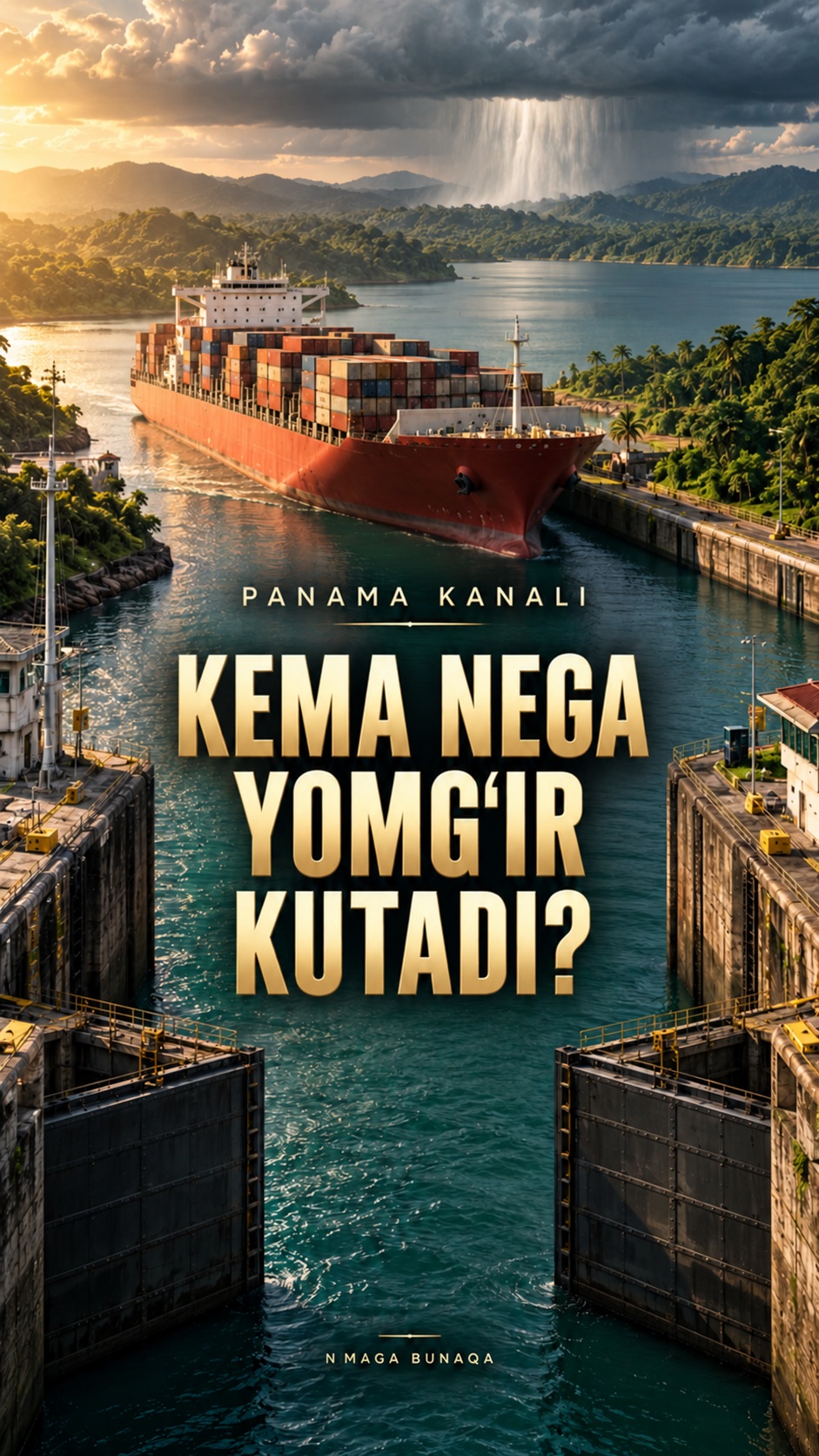
Ships rise to a lake and require fresh water.
Rainfall and demand must be considered together.
Río Indio is planned; 2026 figures are dated.
How many booking slots?
ACP reduced September slots from 34 to 32; its 28 September announcement sets 33 from 15 October. The official announcement was rechecked on 18 October 2026.
Slots are booking capacity, not an exact count of vessels transiting each day. The film shows dated figures, not a live queue counter.
Two ships, one destination
The New York–San Francisco race uses schematic routes. Great-circle segments between the drawn points total about 25,400 km via Cape Horn and 9,400 km via the canal: roughly 16,000 km difference.
These are calculations for our drawn routes, not a navigational plan or shortest route. Vessel speeds, port approaches and canal queues are omitted.
A water staircase and 80 pools
Gatun is about 26 m above sea level. ACP examples give roughly 200 million litres per complete transit. A 50×25×2 m comparison pool gives about 80 pools.
The nine-storey comparison is approximate. Use depends on locks and operations. The new locks’ 60% reuse does not mean a 60% reduction in whole-canal consumption.
Gatun and Charvak: what is compared?
OpenStreetMap water outlines, subtracting islands, give roughly 372 km² and 39 km²: about 9.5 times, rounded to “nearly ten”. The transferred outline retains its scale.
This compares surface area, not water volume or storage. Shorelines may reflect different dates and levels. Outlines are simplified for display.
What replenishes the lake?
Rain over the watershed reaches reservoirs through rivers. World Weather Attribution examines El Niño’s reduced rainfall alongside growing water demand in the 2023 shortage.
Adjacent charts do not prove a single cause. The moving cloud is a diagram, not a tracked Panama cloud. Conservation, demand and infrastructure also matter.
Sixty-one years and dated observations
ACP series: 1965–2026. On 5 October 2026: 85.15 ft = 25.95 m; the 1965–2025 calendar-date mean is about 26.12 m. Series maximum: 29 November 2025, 88.91 ft = 27.10 m. Niño 3.4: +3.2 °C on 30 September.
The long curve uses weekly averages; marked lows use daily observations. Dotted normal is a calendar-day average; dashes are ACP’s projection. Niño 3.4 is not the whole ocean. Dry season: January–April. Release recheck, 18 October 2026: the latest available ACP observation is 17 October, 85.80 ft (26.15184 m), versus the 1965–2025 same-date mean of about 85.9502 ft (26.19761 m): about 4.6 cm lower. The film retains its 5 October data cutoff; it is not live. NOAA’s next weekly Niño 3.4 value is +3.3 °C on 7 October; the film shows +3.2 °C on 30 September.
2023: the price of a queue
ACP reported 22 daily slots in December against the usual 36. IEA records a near-US$4 million slot auction in November.
The December slots and November auction are separate events. The bid was additional to normal tolls; not every ship paid that amount.
One bowl, two needs
ACP says the Gatun–Alhajuela system supplies treated drinking water to more than half of Panama’s population. Ships also depend on that watershed.
The bowl and straws illustrate shared demand. People do not drink untreated lake water, and Gatun alone is not the entire supply system.
Río Indio remains a project
ACP plans a lake linked to Gatun by an approximately 9 km tunnel, with estimated US$1.6 billion cost. Its project page covers studies, resettlement and a 2027–2031 construction period.
This is not a completed lake or guaranteed timetable. Our outline and tunnel are illustrative, not an engineering plan. Affected households and resettlement also matter.
Maps, colours and illustrations
Panama relief: Mapzen Terrain Tiles (USGS SRTM/GMTED2010; NOAA ETOPO1), recoloured with exaggerated hillshade. Globe: NASA Blue Marble and NOAA ETOPO; outlines: Natural Earth and © OpenStreetMap contributors (ODbL).
NOAA OISST v2.1 anomaly colours use 30 September 2026 data. Engraved characters, bowl and cover are original AI illustrations, not historical photographs or exact construction drawings.
Music and typefaces
Investigations by Kevin MacLeod (incompetech.com), Creative Commons BY 4.0; excerpted and faded in this review. Effects are synthesized for the project. Cinzel, Cormorant, Archivo and IBM Plex use SIL OFL.
The music sets a mood; it is not documentary evidence of the events. Its creator and licence are credited above.
About the materials
Panama relief: Mapzen Terrain Tiles (USGS SRTM/GMTED2010; NOAA ETOPO1), recoloured with exaggerated hillshade. Globe: NASA Blue Marble and NOAA ETOPO; outlines: Natural Earth and © OpenStreetMap contributors (ODbL).
Investigations by Kevin MacLeod (incompetech.com). Licensed under Creative Commons: By Attribution 4.0. https://creativecommons.org/licenses/by/4.0/
Music
Found an error?
If you find a specific error or a better source, send us the claim and its link. We will review it and date any correction on this page.
Write to us on Instagram