On this page
Three key points
The caravan triggered war; it was not the sole cause of collapse.
Divided defences and internal conflict aided the Mongol campaign.
Jalal al-Din continued resistance after the sultan’s death.
The caravan as the trigger
The 1218 Otrar caravan, accusation of spying and subsequent envoy’s execution: Barthold, pages 397–399. The figure of 450 is attributed to Juvayni.
The caravan is not presented as the sole cause of imperial collapse. The chronicles differ over responsibility for the killings.
Divided forces and political distrust
Khiwaqi’s advice to concentrate on the Syr Darya, city garrisons and the sultan’s conflict with commanders: Barthold, pages 404–406. Davis considers military and political factors together.
This is historical interpretation. It does not prove that concentration would guarantee victory; army totals are disputed.
Nur, Bukhara and Samarkand
The divided Mongol campaign, guides to Nur and the inhabitants mistaking troops for a caravan: Barthold, pages 406–408. Bukhara: February 1220; Samarkand: March. The fifth-day account is attributed to Juvayni.
Samarkand’s citadel continued resisting after town surrender. The desert route is schematic. The Nur story is a chronicle account, not an independent observation.
Resistance continued
Muhammad died on a Caspian island in December 1220. Jalal al-Din assembled forces at Ghazna and continued resistance: C. E. Bosworth, Iranica.
Rapid collapse in 1220 did not end all resistance. The island marker and incoming banners at Ghazna are illustrative.
Maps, artwork and fonts
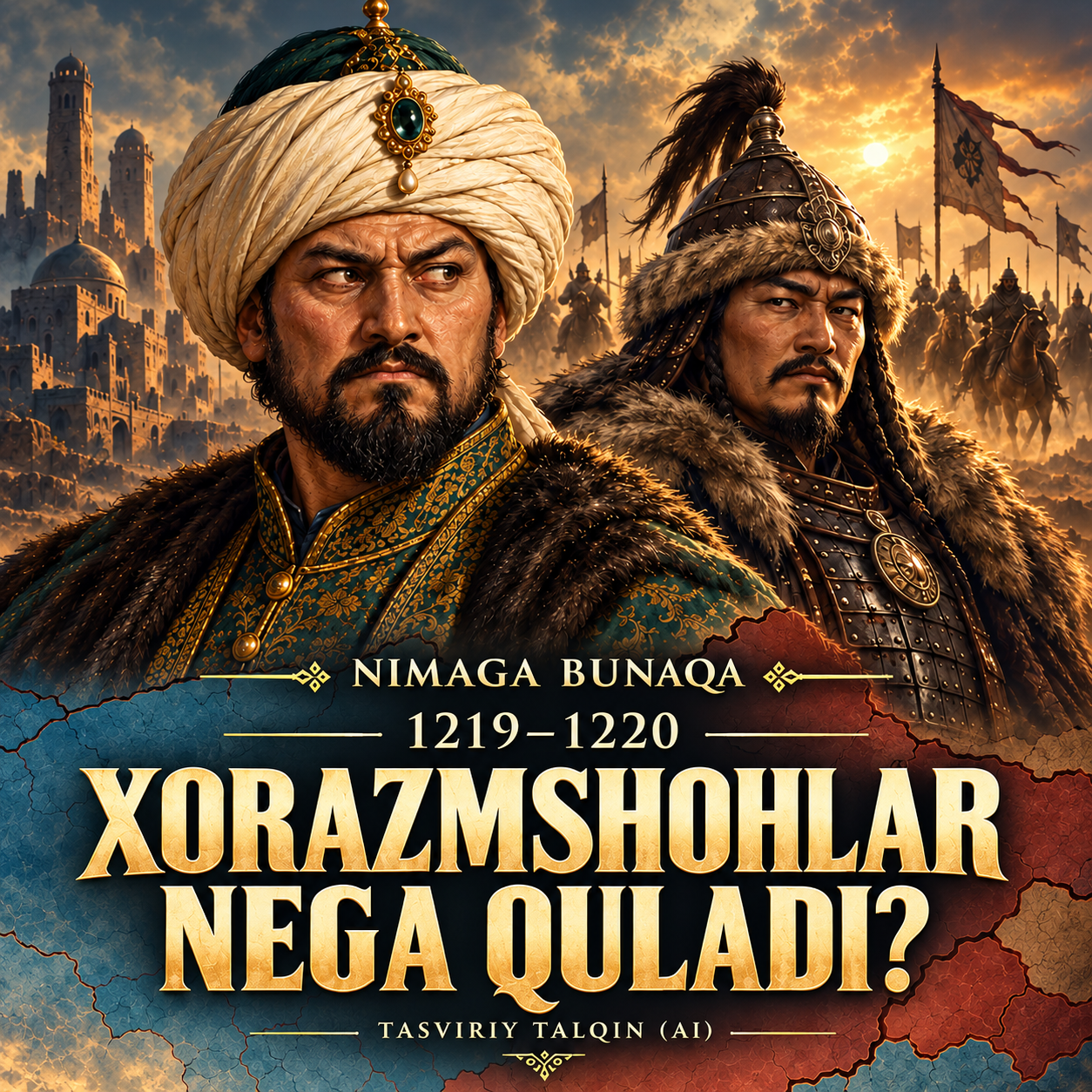
Terrain: NOAA ETOPO 2022; coastlines and rivers: Natural Earth. Genghis’s medallion uses a later Yuan portrait. Five other portraits, three scenes and the covers are channel AI illustrations. Fonts: Cinzel and Cormorant Garamond.
Colours, medieval boundaries, routes and banners are schematic. Modern relief and the older Aral outline do not recover the exact 1220 landscape. AI artwork is not historical evidence or authenticated likeness.
Music and rights
Desert City by Kevin MacLeod (incompetech.com), CC BY 4.0. The track is edited and mixed under speech. Animation and synthesized effects: Nmaga Bunaqa.
The channel did not compose this track. Author attribution remains required; its licence does not verify historical claims.
Supplementary cross-checks
Wikipedia pages recorded in the research ledger to compare chronology. The central evidence is linked above to Barthold, Davis and Iranica.
These are changeable secondary pages. Not every detail about Gurganj or Khujand is included in the short film.
About the materials
Terrain: NOAA NCEI ETOPO 2022, CC0; Natural Earth, public domain.
Yuan-era Genghis portrait: public domain. Other portraits, scenes and covers: AI interpretations.
Desert City by Kevin MacLeod (incompetech.com). CC BY 4.0; track edited.
Found an error?
If you find a specific error or a better source, send us the claim and its link. We will review it and date any correction on this page.
Write to us on Instagram